
Lac qui Parle Court Records After Arrest
The arrest to court path has several steps. Jail booking creates a custody record. The Lac qui Parle County Attorney reviews the law-enforcement referral and decides which formal charges to file. Those charges become part of the court file in Lac Qui Parle County District Court, which has original jurisdiction over criminal and traffic cases filed in the county. The court case, not the jail roster, is the better source for the case number, register of actions, hearing schedule, filed complaint, disposition, sentence, and public court documents.
The local prosecutor is the Lac qui Parle County Attorney, Richard Stulz. The Attorney's Office is listed at 214 6th Avenue, Madison, MN 56256, with phone 320-598-7578. The district court is listed at 600 Sixth Street, Madison, MN 56256, with phone (320) 295-4000 and business hours Monday-Friday, 8:00 a.m.-4:30 p.m. Use the roster for custody status, but use court records after a jail arrest to verify the charges that were actually filed.
For custody-side booking information, the related Lac qui Parle County jail inmate records page addresses the roster fields. Booking photos are a separate records topic, handled through the Lac qui Parle County jail mugshots page.
Search Lac qui Parle Court Records
The main online court tool is Minnesota Court Records Online Case Search, often called MCRO. It is a statewide court access system, not a sheriff roster. Users must accept MCRO terms before searching. Search methods include name, case number, citation number, and attorney. The county filter includes Lac Qui Parle and can help narrow a search to local district court cases.
- Collect roster details first, such as the person's full name, intake date, booking number, and charge statute.
- Open MCRO and accept the terms before using case search.
- Search by defendant name, or use case number when the case is pending and name search is limited.
- Filter the county to Lac Qui Parle when the search form allows it.
- Open case details and the Register of Actions to review filed charges, hearings, judgments, and public documents.
- If records are not remotely available, contact district court or use courthouse public terminals.
The MCRO case-search page screenshot shows the search methods and county-filter style used for Minnesota court records after arrest.
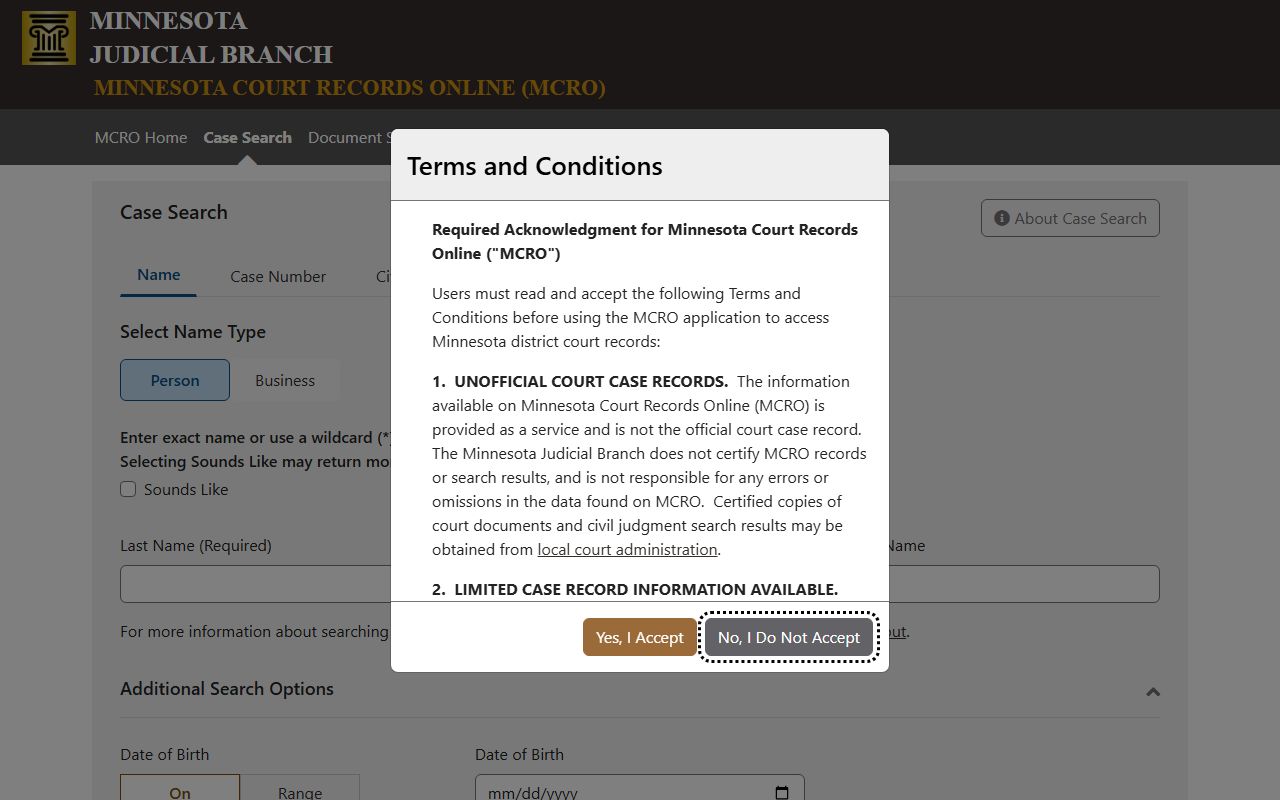
The search form can find public case records, but name-search limits mean case numbers and courthouse terminals still matter.
Lac qui Parle MCRO Search Fields
MCRO is broader than the Lac qui Parle jail roster, so the fields are different. It searches court records after an arrest and other district court case types. The court system warns that MCRO records are not certified official court records. Certified copies must come from court administration.
| Field Label | Type | Required | Options / Notes |
|---|---|---|---|
| Search method | Tab or option | Yes | Name, case number, citation number, or attorney. |
| County filter | Selectable list | Optional | Includes Lac Qui Parle and can be cleared. |
| Find | Button | n/a | Runs the search. |
| Clear | Button | n/a | Clears form fields. |
| Clear Counties Selected | Button or link | n/a | Removes selected county filters. |
| Terms acceptance | Acknowledgment | Required | Must be accepted before searching. |
| Result scope | Case result | n/a | Case details, register of actions, monetary judgments, and public documents when remote access allows. |
Charging Documents After Arrest
After a Lac qui Parle County arrest, the charge listed on the jail roster may be an arrest, remand, sentencing, or court-pending entry. The prosecutor-filed charge is different. In Minnesota criminal practice, a complaint is the common charging document for district court criminal cases. Information and indictment are also charging-document concepts, but the research supports complaint as the usual local path for filed charges after a jail booking.
| Document | Used For | What It Starts |
|---|---|---|
| Complaint | Common Minnesota criminal charging document after prosecutor review. | The district court criminal case and formal charge counts. |
| Information | A prosecutor-filed accusation used in some criminal contexts. | The court case when authorized by procedure. |
| Indictment | Grand jury charging document, generally for the most serious matters. | The court case based on grand jury action. |
Compare the complaint counts against the roster line. Charges can be amended, reduced, dismissed, or replaced, and the court record controls the formal case trail.
Lac qui Parle Charge Status
Charge status is a moving target. A booking charge can reflect the first law-enforcement or court hold, while the complaint reflects the prosecutor's decision. Later entries in the court Register of Actions can show amendments, pleas, dismissal, conviction, sentencing, warrant activity, or other case events. This is the main reason court records after a jail arrest should be checked more than once when the case is new.
| Status | What It Means |
|---|---|
| Pending | The case or count is still open and awaiting court action. |
| Amended | The filed charge or count has changed from an earlier version. |
| Reduced | The charge level or count has been lowered through prosecutor or court action. |
| Dismissed | The count or case was ended without a conviction on that charge. |
| Convicted | A plea or finding established guilt on the count. |
| Sentenced | The court imposed sentence terms after conviction or plea. |
Bond After a Jail Arrest
The Lac qui Parle roster displays bail and bond subfields, but the court controls release conditions. Minnesota Statute 629.471 directs the court to consider factors such as the offense, evidence, community ties, employment, financial resources, residence, prior convictions, court-appearance history, and community safety. Do not treat the sheriff as the office that sets bail. The jail records the custody and bond information it has, while the court sets and changes the release order.
| Release Term | How It Works |
|---|---|
| Cash bail or bond | Money is deposited to secure appearance and compliance. |
| Conditional release | The court allows release with ordered conditions. |
| Recognizance release | The person is released on a promise and conditions when allowed. |
| Surety bond | A bonding company or surety may be used, but no local premium rule was located. |
| No-bond hold | A court order, warrant, probation matter, DOC sentence, or other agency hold can block release. |
Lac qui Parle Arrest Warrants
No official Lac qui Parle County active warrant search was found in the research. The Sheriff's Office page states that the sheriff enforces court orders and warrants, but the county site does not publish a separate public warrant list. A warrant may appear indirectly after arrest, when a person is booked into jail and listed on the In Custody List. A bench warrant may also appear in the district court case file, though MCRO access can be limited for pending cases and by remote-access rules.
For warrant questions, contact the Sheriff's Office main line at 320-598-3720, district court at (320) 295-4000, or the County Attorney's Office when prosecutor information is needed. If a case number is known, MCRO case-number search is often stronger than name search. Active investigative data and some warrant-related records may be classified under Minnesota law, so a data request may not produce every detail.
Charges, Convictions, and Expungement
An arrest and charge are not the same as a conviction. Court records after a jail arrest may show accusations before any plea, trial, or finding of guilt. Minnesota expungement law is found in Chapter 609A. Expungement is a court process that can seal qualifying records from public view, but it is not the same as proving that no arrest occurred, and it does not change every record in every system by default.
| Point | Charge | Conviction |
|---|---|---|
| Stage | Accusation filed or listed in court. | Result after plea, verdict, or finding. |
| Proof | Based on probable cause and prosecutor filing. | Based on plea or proof beyond a reasonable doubt. |
| Record Use | Can change, be amended, or be dismissed. | Controls sentence and later criminal-history effect. |
Sealing and expungement are also distinct in plain terms. Minnesota uses expungement as the main statutory record-sealing path for many criminal records.
| Point | Sealed | Expunged |
|---|---|---|
| Public visibility | Hidden from ordinary public access. | Sealed through the Chapter 609A process when granted. |
| Agency access | Some agencies may retain access under law. | Access depends on the order and statutory exceptions. |
| Eligibility | Depends on case type, outcome, waiting period, and statute. | Requires a court process or statutory authority. |
Restricted Court Records After Arrest
MCRO remote access has limits. The Minnesota Judicial Branch warns that online records are not certified official court records and that remote access is governed by Rule 8 of the Minnesota Rules of Public Access. Some domestic abuse, harassment, child protection, juvenile, civil commitment, address, comment, and confidential materials may be unavailable online. Pending criminal, traffic, and petty misdemeanor cases without conviction may not return by defendant name, so case-number search or courthouse public terminals may be needed.
Important: Do not use casual court or jail lookups for employment, tenant, credit, insurance, or other FCRA-covered decisions.